
Speed Is the New Luxury
In fashion, the brands winning aren't necessarily the ones with the best designs. They're the ones who can get a great design from concept to customer in the shortest possible time.
Zara built a global empire on this principle. But what Zara achieved through vertically integrated manufacturing, today's emerging brands are achieving through digital design tools — specifically, a digital-first workflow built around CLO 3D, Adobe Illustrator, and automated grading systems.
The difference? You don't need Zara's infrastructure. You need the right pipeline.
What "Digital-First" Actually Means
A digital-first design workflow doesn't mean abandoning physical samples entirely. It means moving the majority of design decisions — silhouette, proportion, colorway, fit — into the digital realm so that by the time you cut physical fabric, you're confirming rather than experimenting.
Here's what a typical digital-first pipeline looks like:
Phase 1: Concept and Sketching
Design starts in Procreate, Illustrator, or even pen and paper. But the sketch isn't the deliverable — it's the starting point. The goal is to move from sketch to digital pattern as quickly as possible.
Phase 2: 2D Pattern Development
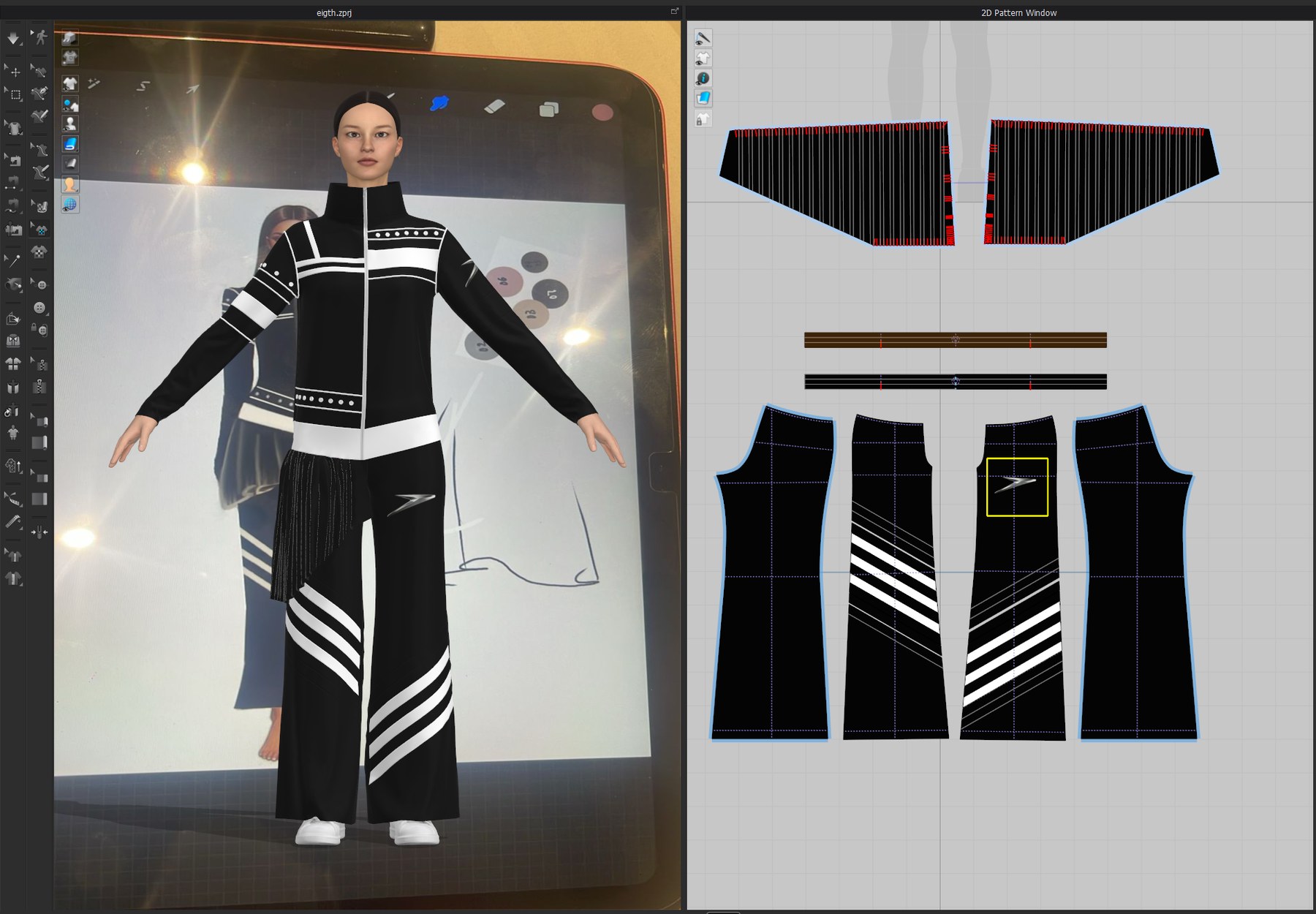
The sketch is translated into a 2D pattern file — either drafted from scratch in CLO 3D's internal pattern tools or imported from Gerber, Lectra, or Optitex as DXF files. This is where construction knowledge matters. The pattern is the blueprint, and getting it right digitally saves weeks of physical iteration.
Phase 3: 3D Simulation and Iteration
The 2D pattern is draped on a 3D avatar in CLO. The designer evaluates fit, drape, proportion, and movement. Changes are made in the 2D pattern and instantly reflected in the 3D view. This loop — adjust, evaluate, adjust — can happen 20 times in a single afternoon. Physically, 20 sample iterations would take months.
Phase 4: Colorway and Fabric Exploration
With the base design approved in 3D, the designer tests different fabrics, prints, and colorways digitally. A single garment can be visualized in 15 colorways in the time it takes to source physical fabric swatches for one.
Phase 5: Tech Pack Generation
The approved 3D design is used to generate manufacturing-ready tech packs — 2D flat illustrations, construction details, BOM, grading charts, and seam specifications — in Illustrator or directly from CLO's export tools.
Phase 6: Production Sampling
The first physical sample is a confirmation sample, not an experimentation sample. The factory receives the tech pack, CLO renders, and DXF files. The garment that comes back should match the 3D design almost exactly.
The Time Savings Are Real
A traditional design-to-sample cycle takes 6–10 weeks per style. A digital-first pipeline compresses that to 2–3 weeks. For a 30-style collection, that's the difference between a 9-month development cycle and a 3-month one.
But speed isn't the only advantage. Digital-first workflows also:
- Reduce sampling costs by 60–80% by eliminating unnecessary physical iterations
- Enable remote collaboration — designers, pattern makers, and factories can review the same 3D file regardless of location
- Improve first-round approval rates — when factories receive accurate 3D references alongside 2D patterns, miscommunication drops dramatically
- Support sustainability goals — fewer samples means less fabric waste, fewer shipping emissions, and a smaller environmental footprint
Who's Doing This Well
The brands adopting digital-first workflows fastest fall into three categories:
Emerging DTC brands who can't afford five rounds of physical sampling and need to get to market quickly with lean budgets.
Sustainable fashion labels who view reduced sampling as both an economic and environmental imperative.
Established brands undergoing digital transformation, replacing legacy PLM systems with integrated 3D design pipelines.
The common thread: they all recognize that the design process is a bottleneck, and digital tools are the way to break through it.
Getting Started
You don't need to overhaul your entire operation on day one. Start with a single style. Develop it digitally in CLO 3D. Generate the tech pack. Send it to your factory with the 3D renders alongside the 2D files. See what comes back.
If the physical sample matches the 3D design — and it will — you'll never go back to the old way.